
Learn Quran Online with Tajweed UK — Ijazah-Certified Teachers

Learning to recite the Quran with Tajweed is one of the most misunderstood goals in Islamic education. Thousands of British Muslims have attended Tajweed classes — at the mosque, online, through apps, through YouTube — and still recite with errors they cannot hear in themselves, applying rules they know theoretically but cannot execute automatically under the pressure of actual recitation.
The reason is not a lack of effort. It is a gap between two very different things: knowing what a rule says, and having that rule become instinctive through the kind of supervised, corrected, repeated oral practice that only a qualified teacher can provide.
At Rattil Online Academy, we offer one-to-one Tajweed classes taught by Ijazah-certified Al-Azhar graduates — teachers who received their knowledge of Quranic recitation through the same authenticated chain of oral transmission that has preserved the Quran unchanged since its revelation. Whether you have been reciting for decades and want to finally fix what is wrong, or whether you are starting from the beginning and want to build correctly from the foundation, this guide explains exactly what our Tajweed programme offers, how it works, and what you can expect from your first class.
What Tajweed Actually Is — and Why Most People Still Get It Wrong After Years of Classes
Tajweed — تجويد — comes from the Arabic root meaning “to perfect” or “to make excellent.” It is the science governing the precise recitation of the Quran: every letter pronounced from its correct articulation point, every rule applied where the text requires it, every quality of each letter preserved in the sound that the reader produces.
The Quran was revealed orally to the Prophet Muhammad ﷺ by the Angel Jibreel, and the Prophet recited it orally to his Companions, who memorised it orally and recited it back, who transmitted it to the next generation in the same way. Tajweed is not a set of rules added later to protect the Quran — it is the codification of the exact way the Quran has always been recited, written down by scholars to preserve what the oral tradition had already established.
This origin matters enormously for understanding why most people who have attended Tajweed classes still recite incorrectly. A rule in a textbook describes a sound. Reading the description does not produce the sound. A YouTube video demonstrates the sound, but the viewer has no way of knowing whether they are producing it correctly. An app can play audio, but it cannot hear what you are actually saying and tell you where you are going wrong.
Tajweed is learned the way it has always been learned: from a qualified teacher who listens to your recitation, hears the errors you cannot hear in yourself, and corrects them — over and over, session after session — until the correct sound is automatic. This is not a limitation of modern technology. It is the nature of the discipline. The Prophet ﷺ said: “The best among you is the one who learns the Quran and teaches it.” The teaching was always oral, always individualised, always corrective. Nothing has changed that.
The Difference Between a Teacher With Ijazah and One Without
When a Rattil Online teacher holds an Ijazah, the word refers to a specific, documented thing: a formal, witnessed permission to teach the Quran, granted by a living scholar who examined that teacher’s recitation in full — every Surah, every rule, every letter — and judged it to meet the standard required for transmission.
That scholar also holds an Ijazah, received from their own teacher, who received it from theirs, in a chain that extends — with every individual named — back to the Companions of the Prophet ﷺ and to the Prophet himself. The Ijazah is not a qualification in the Western academic sense. It is membership in a living chain of transmission: the same mechanism by which the Quran has been preserved orally for over fourteen centuries.
Why this matters practically, not just spiritually:
A teacher with an Ijazah has had their entire recitation examined and verified by a scholar who knows exactly what correct recitation sounds like because they themselves received it through the same chain. The Ijazah-holder knows the Quran at a level of precision that is difficult to acquire any other way — not just the rules as written, but the sounds as they should actually be produced, the subtle qualities of each letter, the way rules interact in real text at recitation speed.
When you learn from a teacher with Ijazah, you receive the same knowledge through them. You are not learning from someone’s interpretation of the rules. You are receiving what the scholars received, what the Companions received, what the Prophet ﷺ received from Jibreel and taught. The chain is the guarantee.
Most online Tajweed platforms do not require their teachers to hold Ijazah. Some require completion of a Tajweed course. Some require a general Islamic studies qualification. Rattil Online requires both an Al-Azhar University degree in Quranic Studies and a personal Ijazah. The difference in the quality of instruction is not marginal.
Who Needs This Programme — Four Types of UK Learners
1. Adults Who Can Read Quran but Recite with Ingrained Errors
This is the most common situation among British Muslim adults. You learned to read the Quran as a child — at the mosque, at home, at madrasah. You can read fluently. You recite in prayer every day. But somewhere, at some point, you became aware that something is not quite right. A letter sounds wrong. A rule is not being applied consistently. You have tried to correct it yourself, tried following YouTube videos, but the errors persist.
The reason they persist is that ingrained recitation habits are almost impossible to correct without a teacher who can hear exactly what you are doing and catch the moment — the precise second — when the error occurs. Most people who try to self-correct end up correcting the version of their recitation they imagine they produce, not the version they actually produce. A qualified teacher hears the actual sound.
Our adult Tajweed correction programme begins with a diagnostic session in which the teacher identifies precisely which errors are present, categorises them by severity and by type, and establishes a correction sequence — the most foundational errors first, so that later corrections build on a repaired foundation.
2. Beginners Starting from Zero
If you have never learned to recite the Quran — whether you are a revert Muslim, or a Muslim who grew up without Quranic education, or simply someone who never had access to a qualified teacher — the best Tajweed you will ever have is the Tajweed you build correctly from the start.
Our beginner programme begins with the Noorani Qaida: the foundations of Arabic letter recognition, pronunciation from correct articulation points, and the basic principles of reading Quranic text. Tajweed is not introduced as a separate subject later — it is built into the learning from the first session. A student who learns the letter ح (Haa) from its correct articulation point from the first day never has to unlearn the incorrect version.
Beginners who start this way consistently achieve better long-term Tajweed than those who learned to read without Tajweed instruction and tried to add it later. There is no better time to start correctly than the beginning.
3. Parents Who Want to Learn Alongside Their Children
A significant number of our UK adult students come to Tajweed classes because their child has started learning and they want to be able to support them — and, often, because seeing their child learn has made them aware of how much their own recitation could be improved.
Adults and children can study simultaneously with separate teachers, or adults can observe their child’s sessions and learn from the same curriculum. The home Quranic environment — a household where the adults also recite carefully and correctly — is one of the most powerful factors in a child’s long-term relationship with the Quran. Parents who invest in their own Tajweed are investing in their children’s as well.
4. Advanced Students Pursuing Ijazah
For students who have completed the Quran with consistent Tajweed and want to receive a formal Ijazah — an authenticated permission to teach with a named chain of transmission — Rattil Online offers Ijazah preparation. Because our teachers themselves hold Ijazah, they can verify your recitation and, upon its completion to the required standard, connect you to the chain. The Ijazah you receive is a document with a real chain, not a certificate of course completion.
This pathway is available to both male and female students. Female students have access to Ijazah through our female teaching programme, which includes the Al-Jazariyya specialisation — enabling sisters to transmit the Quran through an authenticated female chain.
The Complete Tajweed Curriculum — Level by Level
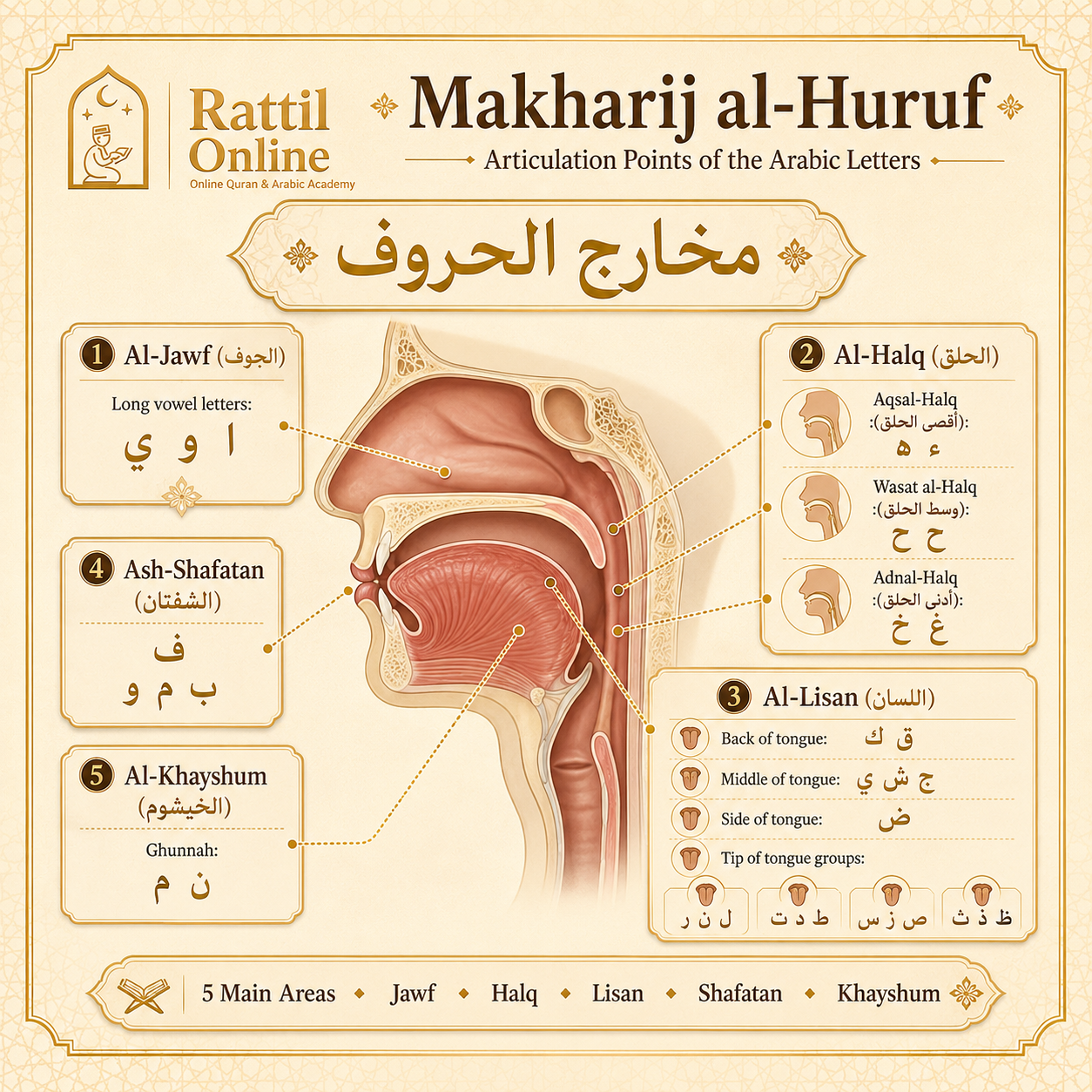
Level One: Makharij al-Huruf — The Foundation of Everything
Before any Tajweed rule can be correctly applied, the letters themselves must be produced correctly. Makharij al-Huruf is the science of the precise articulation points of every Arabic letter — where in the mouth, throat, or nasal cavity each letter originates, and what specific configuration of the tongue, lips, teeth, and throat produces it accurately.
This level is where the majority of existing errors are rooted. Letters that sound similar to the English ear but are produced from entirely different points: ح (Haa, from the throat) and ه (Ha, from further back in the throat); ص (Saad) and س (Seen), which share a surface phonetic similarity but differ in the heaviness and the precise tongue position; ع (Ayn, from a constriction in the pharynx) and a simple glottal stop, which British and American English speakers naturally substitute.
A teacher with Ijazah identifies these substitutions immediately. They hear whether your ض (Daad) is genuinely heavy and lateral, or whether it is approximating something else. They hear whether your ر (Ra) has the correct trill or is being produced as an English approximant. These are not cosmetic differences — they are different letters, and in Quranic text they occur in words where the difference changes meaning.
This level takes as long as it takes. There is no fixed timeline for Makharij, because the work is rebuilding neuromuscular habits around sound production — and that work happens at different rates for different people. Most UK adult students notice significant improvement in their most problematic letters within four to eight weeks of regular one-to-one sessions focused on this level.
Level Two: Noon Saakinah and Tanween
The four rules governing a Noon with a sukoon (ن ْ) and tanween (ً ٍ ٌ) are among the most frequently encountered in Quranic text and the most frequently misapplied even by students who know the rules theoretically:
Idhar (إظهار) — Clear pronunciation of the Noon when followed by the six throat letters (ء ه ع ح غ خ). No ghunnah (nasalisation). No merging. Most students produce some residual nasalisation here even after learning the rule.
Idghaam (إدغام) — Merging of the Noon into the following letter when followed by the six Idghaam letters (ي ر م ل و ن), with ghunnah for the first four and without for Ra and Lam. The distinction between Idghaam with and without ghunnah is where most errors occur.
Iqlaab (إقلاب) — Conversion of the Noon to a Meem sound with ghunnah when followed by a Ba (ب). Technically the simplest rule, but often applied with inconsistent ghunnah duration.
Ikhfaa (إخفاء) — Partial concealment of the Noon with ghunnah when followed by the remaining fifteen letters. This is the most nuanced rule: the Noon is partially merged but not fully merged, held with ghunnah for the duration of approximately two counts. The precise quality of Ikhfaa — not too far toward Idghaam, not too close to Idhar — is what distinguishes careful Tajweed from approximate Tajweed.
Each of these rules is taught in the context of real Quranic text, not in isolated examples. The teacher reads, the student reads, the teacher corrects the specific moment where the error occurred, and the process repeats until the rule is automatic.
Level Three: Meem Saakinah
The three rules governing a Meem with a sukoon (م ْ):
Ikhfaa Shafawi (إخفاء شفوي) — Partial concealment of the Meem with ghunnah when followed by a Ba. Similar in principle to regular Ikhfaa, but produced at the lips.
Idghaam Shafawi (إدغام شفوي) — Merging of the Meem into a following Meem with ghunnah.
Idhar Shafawi (إظهار شفوي) — Clear pronunciation of the Meem when followed by any letter other than Ba or Meem. Errors here tend toward unnecessary nasalisation.
Level Four: The Rules of Madd — Elongation
Madd governs how long vowels are lengthened in recitation. There are several types, each with a specific duration measured in counts (harakat). The major distinctions:
Madd Asli (المد الأصلي) — The natural Madd: two counts. Found wherever a long vowel is not followed by a hamzah or sukoon. Errors here tend toward either shortening (reading a long vowel as short) or over-lengthening.
Madd Muttasil (المد المتصل) — Four or five counts. A long vowel followed immediately by a hamzah within the same word.
Madd Munfasil (المد المنفasil) — Four or five counts. A long vowel at the end of one word followed by a hamzah at the start of the next. This Madd is optional in some readings — the choice (four or five counts) must be consistent throughout a recitation.
Madd Laazim (المد اللازم) — Six counts. The longest Madd, occurring when a long vowel is followed by a sukoon that does not go away — whether from a shaddah or from the sukoon on a letter in a stop. This Madd is mandatory and must be exactly six counts.
Madd Aarid (المد العارض) — Two, four, or six counts. Occurs when a reader stops (waqf) on a word that ends with a letter bearing a short vowel — the vowel is dropped and a sukoon is created, causing a Madd. The reader may choose two, four, or six counts but must be consistent.
UK students frequently apply Madd lengths inconsistently — varying the same type of Madd between two and four counts within the same recitation. The teacher’s role is to establish consistent application through repetition and correction until the durations are automatic.
Level Five: Qalqalah and the Characteristics of Letters
Qalqalah (قلقلة) — an echoing, bouncing quality applied to the five letters ق ط ب ج د when they bear a sukoon. The Qalqalah is stronger at a stop than in the middle of a word, and strongest of all when the letter is also shaddah’d. Many students produce an insufficient Qalqalah — the echo is too short, or the letter is simply stopped rather than released with the characteristic rebound.
Beyond Qalqalah, the characteristics of letters that affect neighbouring sounds: the heaviness (tafkheem) and lightness (tarqeeq) of letters; the distinction between heavy and light Ra; the heaviness of the Laam in the Divine Name الله after a fath or dammah and its lightness after a kasrah; the whispered (hams) and voiced (jahr) qualities of letters; the prolonged constriction (shiddah) and openness (rakhawah) that distinguish letters in the same area of the mouth from one another.
These characteristics are not additional rules to memorise. They are qualities that emerge naturally from correct articulation of each letter — which is why Makharij is taught first. A student who has established correct articulation points will produce many of these qualities automatically. Where they do not, the teacher identifies exactly what is missing.
Level Six: Applied Recitation and Fluency
Knowing every rule is not the same as applying every rule automatically while reciting at normal speed with continuity. The final phase of the Tajweed programme — and the one that takes the longest — is applied recitation: reading through complete Surahs and Juz under teacher supervision, with live correction at the moment of error, until the application of rules is genuinely automatic.
This is where the difference between knowing Tajweed and having Tajweed becomes fully visible. A student can often apply a rule correctly when asked about it in isolation. The same student frequently lapses when reciting fluently, because conscious attention to one rule competes with the simultaneous application of all the others. The path to consistent Tajweed is not knowing more rules — it is reciting under correction until applying the rules takes no conscious attention at all.
Why Learning Tajweed Online Works — and Why Some Formats Work Better Than Others
The common question: can a teacher really correct pronunciation through a screen?
The answer, confirmed consistently by our UK students, is yes — and in one-to-one sessions, more effectively than in most in-person group settings. The teacher’s microphone and speaker system, combined with Zoom or Google Meet’s audio quality, transmits the student’s recitation clearly enough for a trained ear to identify Makharij errors, Madd lengths, the quality of Ghunnah, and the presence or absence of Qalqalah. These are not subtle acoustic events that require physical proximity — they are sounds that a teacher with an Ijazah has spent years learning to identify precisely.
What does not work is group online sessions. In a group session, the teacher hears multiple students or monitors one student while others wait. The individual correction density drops to the same level as a group in-person class. The format that produces Tajweed — individual correction, applied repeatedly, to one student’s specific errors — is one-to-one regardless of whether it happens in person or online.
Students who switched from group online Tajweed classes to one-to-one sessions with Rattil Online consistently report the same observation: they made more progress in the first month of individual sessions than in the previous year of group classes. The mechanism is not complicated. For the first time, every error they produced was heard and corrected within the same session.
Scheduling for UK Students
Our teachers are based in Egypt, operating on Egyptian Standard Time — two hours ahead of GMT in winter, one hour ahead during British Summer Time. The practical result is that teachers are available in the early British morning, the after-work and after-school window, and the evening — all without conflicting with their own Egyptian daytime.
Available session times for UK students:
- Early morning: 6:00 AM — 8:00 AM GMT — suits adults who prefer to begin the day with Quran before work
- Afternoon: 2:00 PM — 5:00 PM GMT — suits shift workers, those working from home, and parents whose children are at school
- Evening: 5:30 PM — 10:00 PM GMT — the most popular window for working professionals
- Weekend: all day from 7:00 AM GMT
Sessions for adult Tajweed students are typically 45 minutes to one hour — long enough for substantive recitation, correction, and reinforcement, without exceeding the concentration that productive correction requires.
Rescheduling is handled directly with the teacher. There are no forfeited sessions for reasonable rescheduling with appropriate notice.
Female Teachers for Sisters — Full Credentials, No Compromise
Our female Tajweed programme is staffed entirely by Al-Azhar certified female teachers who hold Ijazah. The programme includes the Al-Jazariyya Female Quran Teaching Specialisation — a course in the classical Tajweed text of Ibn al-Jazari taught to the level required for Ijazah transmission. Sisters who complete their recitation to the required standard can receive a formal Ijazah through this programme, transmitted through an authenticated female chain.
The quality of Tajweed instruction in the female programme is identical to that of the main programme. There is no difference in the depth of the curriculum, the standard of correction, or the credentials of the teachers. The only difference is the gender of the teacher.
What to Expect — Your First Month
The trial class begins with recitation assessment. You recite what you can — the opening Surahs, a passage from the Quran, whatever represents your current level — and the teacher listens without interruption. After the recitation, the teacher identifies the specific errors present, explains what category each belongs to, and outlines the sequence in which they will be addressed.
Most first-session students are surprised by two things: the number of errors they were unaware of, and how quickly some of them begin to correct. The first category — errors you did not know existed — is almost universal among adults who have been reciting without qualified correction. The brain filters out sounds that feel correct, even when they are not. A trained ear bypasses that filter.
The first four weeks focus on whichever level is most foundational: Makharij for most students, which means focused work on the articulation of the specific letters where errors are concentrated. Sessions involve the teacher modelling correct production, the student attempting to replicate it, the teacher correcting the specific aspect that is still wrong, and the process repeating until the correct sound is stable and reproducible.
By the end of the first month, most students notice the following: they can produce their most problematic letters correctly when they concentrate; the errors in automatic recitation have begun to reduce; and they are aware of their own errors in a way they were not before — which is itself a form of progress, because you cannot correct what you cannot hear.
The path from conscious correct production to automatic correct production is the work of the following months. It is steady, measurable, and cumulative. Every session builds on the last.