Hifz Ijazah vs Tilawah Certificate: A Complete Guide for Quran Students
Introduction
Many students and parents come across terms such as Hifz Ijazah, Tilawah Certificate, Quran Ijazah with Sanad, and Quran Recitation Certificate. Sometimes, these terms are used in different ways by different academies, which may cause confusion.
Some people think that every Quran certificate is an Ijazah, while others believe that mastering recitation automatically gives a person the right to grant Ijazah to others. However, there is an important difference between a Tilawah Certificate and a Hifz Ijazah with a connected chain of transmission.
Both are honorable achievements in the journey of learning the Quran, but they are not the same. A Tilawah Certificate usually confirms that a student has mastered Quran recitation with correct Tajweed, while a Hifz Ijazah is a higher level of Quranic certification connected to memorization, mastery, and an authenticated chain of transmission back to the Prophet Muhammad ﷺ.
In this guide, we will explain the difference between a Hifz Ijazah and a Tilawah Certificate in detail, what Sanad means, who can grant Ijazah, and which path is suitable for each student.
What Is a Tilawah Certificate?
A Tilawah Certificate is a certificate given to a student who has mastered the recitation of the Holy Quran with correct Tajweed, proper pronunciation, and accurate application of the rules of recitation.
This means that the student can read the Quran correctly, paying attention to:
- The correct pronunciation of Arabic letters.
- The articulation points of letters, known as Makharij.
- The characteristics of letters, known as Sifat.
- The rules of Tajweed, such as Ikhfa, Idgham, Izhar, Iqlab, Ghunnah, Madd, Qalqalah, and other recitation rules.
- Proper fluency and clarity in recitation.
- Correct reading from the Mushaf.
A Tilawah Certificate confirms that the student has reached a good or advanced level in Quran recitation. It may be awarded after completing a recitation course, reading selected parts of the Quran, or completing a full reading of the Quran by looking from the Mushaf, depending on the academy or teacher.
However, it is very important to understand that a Tilawah Certificate is not necessarily an Ijazah with Sanad. It usually does not give the student permission to grant Ijazah to others, unless the certificate clearly states that it includes a connected Sanad and permission from a qualified Sheikh.
What Is the Purpose of a Tilawah Certificate?
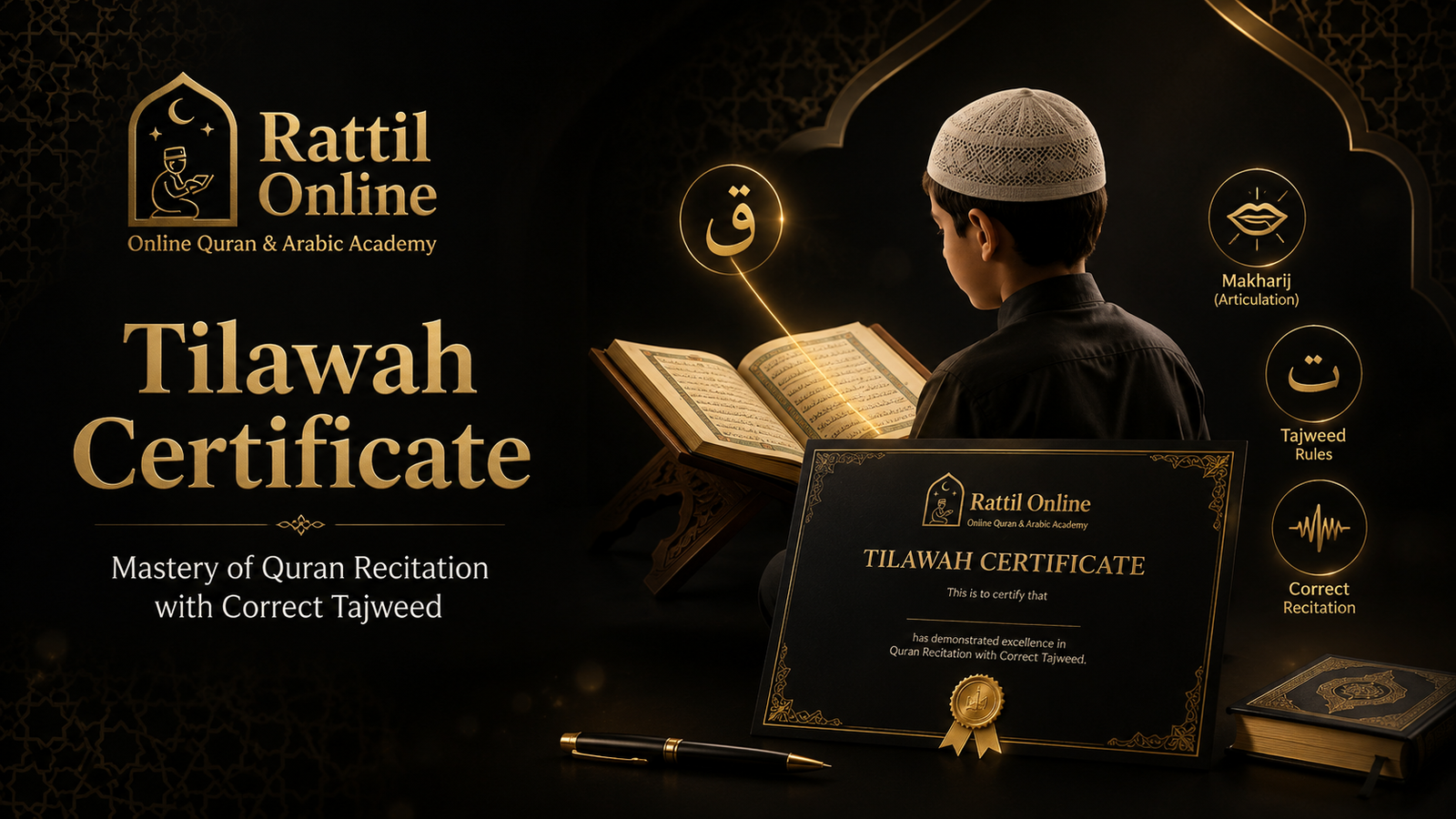
The main purpose of a Tilawah Certificate is to confirm that the student can recite the Quran properly and has studied the rules of Tajweed under the supervision of a qualified teacher.
A Tilawah Certificate is useful because it:
- Confirms the student’s level in Quran recitation.
- Shows that the student has learned correct Tajweed.
- Encourages the student to continue improving.
- Helps parents understand their child’s progress.
- Prepares the student for more advanced Quranic studies.
- Can be a step before starting Hifz or preparing for Ijazah.
For this reason, a Tilawah Certificate is an important achievement, especially for students who want to improve their Quran reading, correct their mistakes, and build a strong foundation before memorizing the Quran.
Does a Tilawah Certificate Allow Someone to Grant Ijazah?
No. A Tilawah Certificate does not allow someone to grant Ijazah to others.
The reason is simple: a Tilawah Certificate usually confirms that the student has mastered recitation, but it does not necessarily prove that the student has received a connected chain of transmission, known as Sanad, or permission from a qualified Sheikh to teach and grant Ijazah.
Granting Ijazah in the Quran is not based only on beautiful recitation or knowing the rules of Tajweed. It requires a higher level of mastery, discipline, and authorization.
A person who grants Ijazah must usually have:
- Recited the entire Quran to a qualified Sheikh.
- Mastered the specific narration, such as Hafs ‘an Asim.
- Received an authenticated Sanad connected to the Prophet Muhammad ﷺ.
- Been given permission by their Sheikh to teach and transmit the Quran.
- Strong knowledge of Tajweed, recitation, and correction of mistakes.
- Honesty, accuracy, and responsibility in transmitting the Quran.
Therefore, a student who has a Tilawah Certificate may be able to recite well and may even teach basic recitation if they are qualified to do so, but they cannot grant Quran Ijazah simply because they have a Tilawah Certificate.
What Is a Hifz Ijazah?
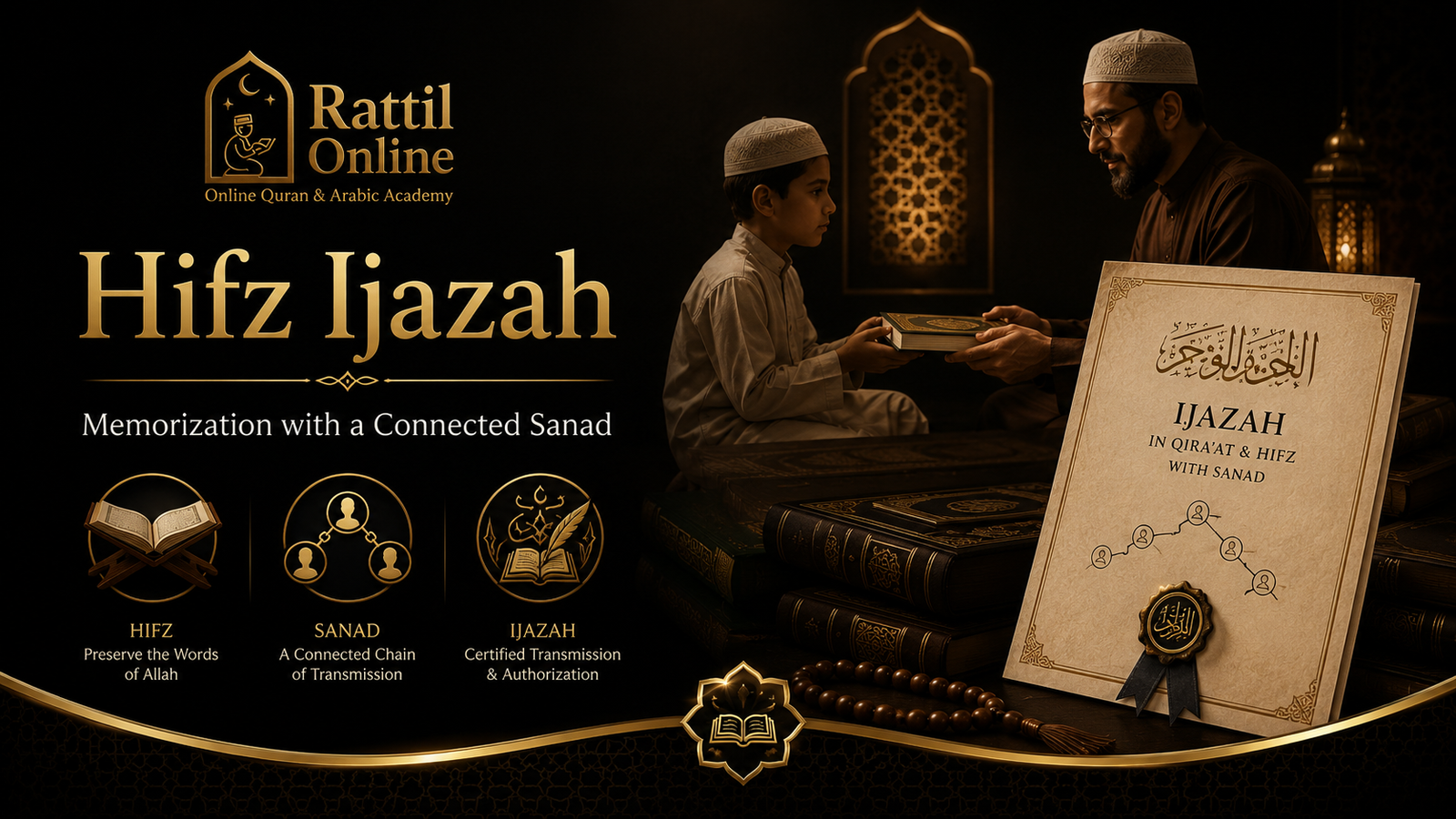
A Hifz Ijazah is a special Quranic certification given to a student who has memorized the entire Quran and recited it from memory to a qualified Sheikh with accuracy, proper Tajweed, and mastery.
The word Hifz means memorization. Therefore, a Hifz Ijazah is related to memorizing the Quran completely and presenting that memorization to a qualified teacher.
A Hifz Ijazah is not just a certificate of completion. It is usually connected to a Sanad, which means a chain of transmission going back from the student to their teacher, from the teacher to their teacher, and so on until the chain reaches the Prophet Muhammad ﷺ, who received the Quran from Angel Jibreel عليه السلام from Allah سبحانه وتعالى.
This makes the Hifz Ijazah a very honorable and serious achievement. It connects the student to the long tradition of Quran transmission through direct recitation, listening, correction, and mastery.
What Does Sanad Mean in Quran Recitation?
Sanad means a chain of transmission.
In Quran learning, Sanad refers to the chain of teachers and reciters who transmitted the Quran from one generation to another through direct oral recitation.
For example, a student reads the Quran to a qualified Sheikh. That Sheikh read the Quran to his Sheikh, and his Sheikh read to his Sheikh, and the chain continues until it reaches the Prophet Muhammad ﷺ.
The Prophet Muhammad ﷺ received the Quran from Angel Jibreel عليه السلام, who brought the revelation from Allah سبحانه وتعالى.
This connected chain is one of the greatest honors of the Muslim Ummah. The Quran was not only preserved in writing, but also preserved through accurate oral transmission from teacher to student.
That is why the Quran is traditionally learned by reciting to a qualified teacher, not only by reading alone from the Mushaf. The teacher listens, corrects, guides, and ensures that the student recites properly.
The Main Difference Between a Hifz Ijazah and a Tilawah Certificate
Although both a Hifz Ijazah and a Tilawah Certificate are related to Quran learning, they are different in purpose, level, and authority.
1. Difference in Meaning
A Tilawah Certificate confirms that a student has mastered Quran recitation with correct Tajweed and pronunciation.
A Hifz Ijazah confirms that a student has memorized the entire Quran, recited it from memory to a qualified Sheikh, and received a connected chain of transmission.
2. Difference in Sanad
A Tilawah Certificate does not necessarily include a connected Sanad. It is often a certificate of achievement, completion, or recitation proficiency.
A Hifz Ijazah is usually connected to a Sanad that goes back to the Prophet Muhammad ﷺ, through the chain of qualified reciters and teachers.
3. Difference in Recitation Method
A Tilawah Certificate may be based on reading from the Mushaf. The focus is on correct recitation, pronunciation, and Tajweed.
A Hifz Ijazah is usually based on reciting the entire Quran from memory, with accuracy and strong retention.
4. Difference in Academic Level
A Tilawah Certificate is an important educational achievement that proves recitation ability.
A Hifz Ijazah is a higher Quranic achievement because it combines memorization, Tajweed, complete recitation, mastery, and Sanad.
5. Difference in Authority
A Tilawah Certificate does not give the student the authority to grant Ijazah to others.
A Hifz Ijazah may allow the student to teach and grant Ijazah to others, but only if the Sheikh has given permission and the student has fulfilled the conditions required to become a qualified Quran teacher and certifier.
Comparison Table: Hifz Ijazah vs Tilawah Certificate
| Point of Comparison | Tilawah Certificate | Hifz Ijazah |
|---|---|---|
| Main Purpose | To confirm mastery of recitation and Tajweed | To confirm memorization of the entire Quran with Sanad |
| Recitation Method | Often by reading from the Mushaf | Usually from memory |
| Sanad | Not necessarily included | Usually includes a connected Sanad |
| Authority to Grant Ijazah | Does not give this authority | May give this authority if permission is granted by the Sheikh |
| Level | Recitation proficiency certificate | Higher Quranic certification |
| Suitable For | Students improving Quran reading and Tajweed | Students who memorized the entire Quran |
| Focus | Correct recitation and Tajweed | Memorization, Tajweed, mastery, and chain of transmission |
Is Every Quran Memorizer Considered a Person with Ijazah?
No. Not every person who memorizes the Quran is automatically considered a holder of Ijazah.
A person may memorize the entire Quran, and this is a great blessing and achievement, but they are not considered officially licensed with Ijazah unless they have recited the Quran to a qualified Sheikh, completed the requirements, and received permission or certification from that Sheikh.
There is a difference between:
- A person who has memorized the Quran.
- A person who has memorized the Quran with strong revision.
- A person who has memorized and mastered Tajweed.
- A person who has recited the entire Quran to a qualified Sheikh.
- A person who has received Hifz Ijazah with connected Sanad.
- A person who has permission to teach and grant Ijazah to others.
Each level has its own value, but they are not all the same.
Is Every Good Quran Reciter Considered a Person with Ijazah?
No. A person may have a beautiful voice and good recitation, but that does not automatically mean they have Ijazah.
Ijazah is not based only on voice quality. It is based on accurate recitation, mastery of the narration, reading the Quran to a qualified Sheikh, and receiving an authenticated chain of transmission.
A student may be excellent in Tilawah and Tajweed, but if they have not completed the requirements of Ijazah, they should not claim to be a holder of Ijazah.
General Conditions for Receiving a Hifz Ijazah
The exact conditions may vary from one Sheikh or institution to another, but the general requirements usually include the following:
1. Complete Memorization of the Quran
The student must memorize the entire Quran, not only selected Surahs or Juz’. The memorization should be strong and stable.
2. Correct Tajweed
The student must recite with correct Tajweed, including proper pronunciation, articulation points, letter characteristics, and practical application of recitation rules.
3. Reading to a Qualified Sheikh
The student must recite the Quran to a qualified Sheikh who has Ijazah and is authorized to teach and certify others.
4. Reciting the Entire Quran from Memory
For Hifz Ijazah, the student usually recites the entire Quran from memory to the Sheikh. The Sheikh listens carefully, corrects mistakes, and checks the student’s accuracy.
5. Mastery of the Narration
The student should be aware of the narration being recited, such as Hafs ‘an Asim, Warsh ‘an Nafi’, or another recognized narration.
6. Final Review and Testing
Many teachers require a final test or complete revision before granting Ijazah, to make sure the student’s memorization and recitation are strong.
Can a Person with Hifz Ijazah Grant Ijazah to Others?
The accurate answer is: a person with Hifz Ijazah may be able to grant Ijazah to others if their Sheikh has given them permission and they are qualified to do so.
Not every written Ijazah has the same wording. Some Ijazahs confirm that the student memorized and recited the Quran. Others also give permission to teach and grant Ijazah.
Therefore, it is important to look at the wording of the Ijazah itself.
A qualified person who grants Ijazah should have:
- Strong memorization.
- Correct Tajweed.
- Knowledge of the narration.
- Permission from their Sheikh.
- Ability to correct students.
- Responsibility and honesty in transmitting the Quran.
- Good understanding of the rules of recitation.
So, while Hifz Ijazah is higher than a Tilawah Certificate, the authority to grant Ijazah should be treated seriously and should depend on the permission and qualification of the person.
Why Is a Tilawah Certificate Still Important?
Even though a Tilawah Certificate does not give the right to grant Ijazah, it is still very important.
Many students cannot start Hifz properly until they first correct their recitation. If a student memorizes with mistakes, those mistakes may become difficult to fix later.
A Tilawah Certificate helps the student:
- Correct pronunciation mistakes.
- Learn Tajweed step by step.
- Improve fluency in reading.
- Build confidence in Quran recitation.
- Prepare for memorization.
- Prepare for future Ijazah studies.
For beginners and intermediate students, mastering Tilawah is one of the most important steps in their Quran journey.
Which One Is Better: Tilawah Certificate or Hifz Ijazah?
It is not correct to say that one is useful and the other is not. Both are valuable, but they serve different purposes.
A Tilawah Certificate is suitable for students who want to improve their reading, correct their Tajweed, and build a strong foundation.
A Hifz Ijazah is suitable for students who have memorized the entire Quran and want to reach a higher level of mastery with connected Sanad.
The correct path usually looks like this:
Correct Recitation → Tajweed Mastery → Quran Memorization → Strong Revision → Complete Recitation to a Qualified Sheikh → Hifz Ijazah with Sanad
So, a Tilawah Certificate can be seen as an important step on the road toward Hifz and Ijazah.
Common Mistakes About Quran Certificates
Mistake 1: Thinking Every Quran Certificate Is an Ijazah
Not every Quran certificate is an Ijazah. Some certificates are for attendance, completion, Tajweed, recitation, or memorization progress.
Mistake 2: Thinking a Beautiful Voice Is Enough for Ijazah
A beautiful voice is a blessing, but Ijazah requires accuracy, mastery, and proper transmission.
Mistake 3: Confusing Memorization with Ijazah
Memorizing the Quran is a great achievement, but Ijazah requires reciting to a qualified Sheikh and fulfilling specific conditions.
Mistake 4: Thinking a Tilawah Certificate Allows Someone to Grant Ijazah
A Tilawah Certificate confirms recitation ability, but it does not give the authority to grant Ijazah to others.
Mistake 5: Not Reading the Certificate Carefully
Students and parents should read the wording of the certificate. Does it say “Certificate of Completion”? “Tilawah Certificate”? “Ijazah with Sanad”? “Permission to teach and grant Ijazah”? These details matter.
How Can You Know If a Certificate Is a Real Ijazah?
To know whether a certificate is truly an Ijazah, check the following:
- The Sheikh is qualified and has Ijazah.
- The student recited the entire Quran to the Sheikh.
- The narration is clearly mentioned.
- The Sanad is connected and known.
- The wording of the Ijazah is clear.
- It states what the student was granted: recitation, memorization, narration, or permission to teach.
- It is clear whether the student is allowed to grant Ijazah to others.
A real Ijazah is not just a decorative certificate. It represents trust, responsibility, and accurate transmission of the Quran.
Can Quran Ijazah Be Studied Online?
Yes, many students today study Quran, Tajweed, Hifz, and even Ijazah programs online. However, the most important condition is not whether the class is online or in person. The most important condition is the quality of recitation, correction, listening, and mastery.
Online Quran Ijazah may be possible if:
- The teacher is qualified and authorized.
- The student recites live to the teacher.
- The sound quality is clear.
- The teacher carefully corrects mistakes.
- The student completes the required recitation.
- The student reaches the required level of mastery.
Online learning can be very effective when it is done seriously and with qualified teachers.
Who Should Study for a Tilawah Certificate?
A Tilawah Certificate is suitable for:
- Children learning to read the Quran.
- Adults who want to improve their recitation.
- Students who struggle with Arabic pronunciation.
- Students who want to learn Tajweed.
- Beginners who want to read the Quran correctly.
- Students preparing for Quran memorization.
- Anyone who wants to recite the Quran with confidence.
Who Should Study for a Hifz Ijazah?
A Hifz Ijazah is suitable for:
- Students who have memorized the entire Quran.
- Students with strong and stable revision.
- Students who can recite from memory with correct Tajweed.
- Students who want a connected Sanad.
- Students who want to become qualified Quran teachers.
- Students who want to continue the tradition of Quran transmission.
The Practical Path from Tilawah to Hifz Ijazah
A student can begin with Tilawah and gradually progress toward Hifz Ijazah.
Stage 1: Correcting Recitation
The student learns proper pronunciation, Makharij, Sifat, and basic Tajweed rules.
Stage 2: Practical Tajweed
The student applies Tajweed rules during real recitation, not only in theory.
Stage 3: Quran Memorization
The student starts memorizing with a clear plan and regular revision.
Stage 4: Strong Revision
After completing memorization, the student reviews the entire Quran carefully until the memorization becomes strong.
Stage 5: Reciting to a Qualified Sheikh
The student recites the entire Quran to a qualified Sheikh who listens, corrects, and evaluates the student.
Stage 6: Receiving Hifz Ijazah
After completing the requirements and reaching the required level of mastery, the student may receive Hifz Ijazah with Sanad.
How Rattil Online Academy Helps Students in This Journey
At Rattil Online Academy, we believe that learning the Quran should be based on clarity, step-by-step progress, and proper guidance.
We help students begin with correct recitation, then move to Tajweed, memorization, revision, and preparation for advanced Quranic study.
Our teachers focus on helping each student understand their current level and the next step they need. A beginner may start with Noorani Qaida or Quran reading. An intermediate student may focus on Tajweed and fluency. A memorizer may focus on revision and preparation for Hifz Ijazah.
We also make sure that students and parents understand the difference between a Tilawah Certificate and a Hifz Ijazah, so there is no confusion between a recitation certificate and an Ijazah with Sanad.
Our online Quran classes are suitable for children and adults, beginners and advanced students, with qualified male and female teachers.
Conclusion
The difference between a Tilawah Certificate and a Hifz Ijazah is important for every Quran student and every parent.
A Tilawah Certificate confirms that the student has mastered Quran recitation with correct Tajweed. It is an important achievement, but it does not give the student the right to grant Ijazah to others.
A Hifz Ijazah is a higher Quranic certification. It is given to a student who has memorized the entire Quran, recited it to a qualified Sheikh, and received a connected chain of transmission back to the Prophet Muhammad ﷺ, who received the Quran from Angel Jibreel عليه السلام from Allah سبحانه وتعالى.
A person with Hifz Ijazah may be able to teach and grant Ijazah to others if their Sheikh has given them permission and they have fulfilled the required conditions of knowledge, mastery, accuracy, and trustworthiness.
Both certificates are valuable, but each one has its own meaning, level, and purpose. The Tilawah Certificate is a beautiful step toward correct recitation, while the Hifz Ijazah is a higher level connected to memorization, mastery, and Sanad.
Frequently Asked Questions
What is the difference between a Hifz Ijazah and a Tilawah Certificate?
A Tilawah Certificate confirms that the student can recite the Quran correctly with Tajweed. A Hifz Ijazah confirms that the student has memorized the entire Quran and recited it to a qualified Sheikh with a connected Sanad.
Is a Tilawah Certificate the same as an Ijazah?
No. A Tilawah Certificate is not necessarily an Ijazah. It usually confirms recitation proficiency, while Ijazah includes a connected chain of transmission and permission from a qualified Sheikh.
Can someone with a Tilawah Certificate grant Ijazah?
No. A Tilawah Certificate does not give the authority to grant Ijazah to others.
Can someone with Hifz Ijazah grant Ijazah?
They may be able to do so if their Sheikh has given them permission and they have fulfilled the conditions required to teach and grant Ijazah.
Is every Hafiz automatically a person with Ijazah?
No. A Hafiz is someone who has memorized the Quran. A person with Ijazah has recited the Quran to a qualified Sheikh and received certification or permission through a connected chain.
Can I study Quran Ijazah online?
Yes, it may be possible to study Ijazah online if the teacher is qualified, the student recites live, the sound quality is clear, and the student fulfills all requirements with accuracy and mastery.
What should a beginner start with?
A beginner should start with correcting recitation, learning Tajweed, and building fluency before moving to Hifz and Ijazah preparation.
Call to Action
If you or your child want to learn Quran recitation with correct Tajweed, improve memorization, or prepare for advanced Quranic study, Rattil Online Academy can help you step by step.
Start with proper recitation, build strong Tajweed, memorize with a clear plan, and progress toward Quran mastery with qualified teachers.
Book your free trial class today with Rattil Online Academy and begin your Quran journey with confidence.