Good manners were among the key teachings that the Prophet Muhammad ﷺ consistently advised his Companions to uphold, and this guidance extends to the entire Muslim Ummah after them. The Messenger of Allah ﷺ said: “Fear Allah wherever you are, follow a bad deed with a good deed and it will erase it, and treat people with good character.”
Kindness is a noble quality that encompasses the finest moral virtues and serves as the foundation of good conduct. It is also an important topic in islamic studies for kids online. Hadith on Kindness is one of the most beautiful ways to introduce children to Islamic character. The Prophet Muhammad ﷺ taught that kindness is not merely a good habit but a quality loved by Allah and reflected in every aspect of a believer’s life.
When children grow up understanding the value of mercy, compassion, respect, and good manners, they become confident Muslims who positively influence their families and communities. So, we will explore what the Sunnah teaches about kindness, how parents can nurture this noble character at home, and how islamic studies for kids online helps transform Islamic knowledge into lifelong habits.
Help your child build strong Islamic values. Book a free trial class today.
The Meaning of Kindness in the Sunnah
Kindness (rifq) occupies a central place in Islam. Being gentle in all matters brings about improvement and leads to the best outcomes, whereas harshness often causes harm and results in the worst consequences. Whoever is blessed with gentleness has been granted abundant goodness, while whoever is deprived of it has been deprived of all goodness as the Prophet Muhammad ﷺ said:
“Indeed, Allah is Kind and loves kindness in all matters.”
Gentleness is one of the sublime attributes of Allah Almighty. Our Lord, Glorified and Exalted is He, is Gentle with His creation, Compassionate toward His servants, and Most Generous in His forgiveness. His commands and prohibitions are marked by gentleness; He does not burden His servants with unbearable obligations or require of them what is beyond their capacity. Allah, the Exalted, says:
“So fear Allah as much as you are able.” (Qur’an 64:16)
“Allah does not burden a soul beyond what it can bear.” (Qur’an 2:286)
For children, understanding this manner helps them realise that being kind is an act of worship. Saying kind words, sharing toys, respecting parents, helping classmates, and caring for younger siblings are all opportunities to earn reward from Allah.
Studying these teachings through islamic studies for kids online allows children to understand the meaning behind the hadith instead of merely memorising its words.
Why Kindness Is One of the Greatest Islamic Values
Islam teaches that faith and good character are inseparable. A person of good character is recognized as having complete and strong faith. The Prophet Muhammad ﷺ said:
“There is nothing heavier on the Scale than good character.”
He also said in another Hadith:
“The believers with the most complete faith are those who have the best character.”
Because of the great importance of good character, the Prophet Muhammad ﷺ frequently supplicated to Allah, asking Him to grant him the best of manners and to keep him away from bad character. Among his supplications was:
“O Allah, guide me to the best of manners, for none can guide to the best of them except You. And turn me away from bad manners, for none can turn me away from them except You.”
Teaching kindness from an early age also develops qualities such as:
- Respect for parents and elders.
- Compassion toward younger children.
- Honesty and trustworthiness.
- Patience during difficulties.
- Generosity and helpfulness.
- Forgiveness instead of anger.
Children who consistently learn these values understand that Islamic manners are not limited to the mosque. They influence behaviour at school, at home, online, and with friends.
This holistic understanding is one reason many families choose islamic studies for kids online. Lessons combine Islamic beliefs with practical examples that children can immediately apply in everyday situations.

Examples of Kindness from the Life of Prophet Muhammad ﷺ
The Seerah is filled with examples that help children understand kindness through real events.
His kindness toward children
The Prophet ﷺ welcomed children with warmth and affection. He greeted them, smiled at them, carried his grandchildren, and shortened the prayer when hearing a child cry so the mother would not become distressed.
One of the most beautiful stories we can tell children is the narration of Anas ﷺ, who said:
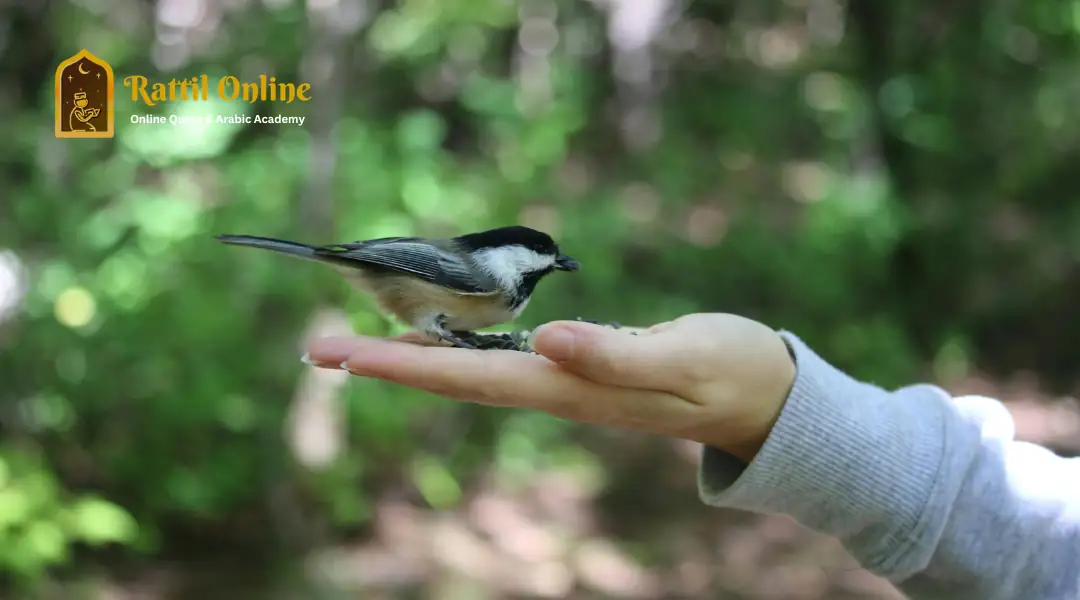
The Messenger of Allah ﷺ used to visit us. I had a younger brother (called Abu Umayr) who had a small bird (nughayr) that he used to play with. The bird died, and one day the Prophet ﷺ came and saw him looking sad. He asked:
“Why is Abu Umayr sad?”
They replied, “O Messenger of Allah, his little bird that he used to play with has died.”
The Messenger of Allah ﷺ sat beside him to comfort him and speak with him, saying:
“O Abu Umayr, what happened to the little bird? O Abu Umayr, what happened to the little bird?”
By these words, the Prophet (peace and blessings be upon him) intended to joke with the young boy and make him smile, so as to relieve the sadness that had come over him.
His kindness toward neighbours
The Prophet ﷺ repeatedly advised Muslims to honour their neighbours. Regardless of their background, neighbours deserve respect, assistance, and consideration.
Children can practise this by greeting neighbours politely, avoiding behaviour that causes harm, and helping whenever possible.
His kindness toward animals
The Messenger of Allah ﷺ instructed Muslims to treat animals with mercy. Feeding them, avoiding unnecessary harm, and caring for them are acts rewarded by Allah.
These stories become much more meaningful when children study them in islamic studies for kids online, where qualified teachers explain the lessons behind each event and encourage practical application.
How Islamic Studies for Kids Online Turn the Hadith into Daily Manners
Parents often think about how they can help their child use Islamic knowledge in their everyday life, so it doesn’t get forgotten quickly. The answer lies in continuous learning, skilled teachers, and real-world application. At Rattil Academy, islamic studies for kids online follows a planned program that helps children learn about Islam and develop good character at their own speed.
Children study important topics like Aqeedah, Fiqh, Seerah, Hadith, Tafsir, and how to behave according to Islamic values. Every lesson links these topics to real-life scenarios, so students can practice being kind, respectful, patient, and responsible at home, at school, and in their communities. This approach turns islamic studies for kids online into a path of developing good character, not just about learning subjects.
Qualified teachers at Rattil Academy break down each lesson so kids can understand it easily, using live and recorded classes, giving personal feedback, and keeping track of their progress regularly. Many families like that online islamic classes for kids have flexible timing, which helps them fit Islamic lessons into their regular school and family routines more easily.
Help Your Child Grow with Kindness Through Islamic Studies for Kids Online
Children learn good manners best when parents and teachers work together. While parents provide daily guidance and positive examples, islamic studies for kids online helps children understand how Islamic teachings can be applied in real life through consistent learning and authentic guidance.
Build Kindness Through Simple Daily Habits
Small daily actions can make a lasting difference. Read a short hadith together each week, encourage one act of kindness every day, and praise honesty, patience, and respect whenever your child demonstrates them.
Make Learning Fun and Engaging
Children learn more effectively when lessons are enjoyable and interactive. At Rattil Academy, experienced teachers use age-appropriate teaching methods, discussions, stories from the Seerah, engaging activities, and practical examples to make Islamic learning meaningful and enjoyable for young learners.
Combine Qur’an Learning with Islamic Studies
Pairing online quran classes for kids with Islamic Studies gives children a well-rounded Islamic education. A qualified quran teacher for kids online helps improve Qur’an recitation while reinforcing kindness, respect, and other Islamic values, making islam for kids online a complete journey of knowledge and character.
Start Your Child’s Journey Today
Give your child the opportunity to build strong faith, excellent manners, and a love for learning Islam through islamic studies for kids online at Rattil Academy.
Conclusion
Kindness is one of the defining qualities of a Muslim, and the Sunnah provides countless examples that inspire children to become compassionate, respectful, and responsible individuals. Teaching the Hadith on Kindness is not simply about memorising words; it is about shaping hearts and building lifelong habits.
Book a free trial class at Rattil Academy and discover how islamic studies for kids online can help your child grow in knowledge, confidence, and good character.
FAQs
Why is the Hadith on Kindness important for children?
It teaches children that kindness is an act of worship loved by Allah. Learning these teachings early helps build good manners that remain throughout life.
How does islamic studies for kids online improve a child’s character?
Islamic studies for kids online combines Islamic knowledge with practical lessons that encourage honesty, patience, respect, compassion, and responsibility in everyday situations.
Is islamic studies for kids online suitable for beginners?
Yes. The curriculum is personalised according to each student’s age, previous knowledge, and learning goals, making it suitable for beginners as well as more advanced learners.